
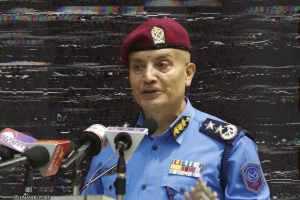
Gaurav Pokharel
As Nepal’s police chief, Dan Bahadur Karki kept reminding the prime minister’s secretariat what the law allowed. Ultimately, that became a reason he lost the job, multiple government officials told Kantipur.
On Wednesday afternoon, an emergency Cabinet meeting removed Inspector General of Police Karki from his post and made him security adviser to the prime minister, a move the government insists is not punitive. But accounts from officials at the prime minister’s secretariat and at Police Headquarters point to deeper causes: Karki’s handling of the Inam Sapkota investigation, his resistance to orders for immediate arrests, and a long-standing wish in Balendra Shah’s camp to see AIG Manoj KC lead the force.
After the meeting, government spokesperson Sasmit Pokharel said nothing about any dissatisfaction with Karki. He said only that a new post had been created and for Karki, it was only a change of responsibility.
Prime Minister Balendra Shah, however, wanted Karki out at a regular Cabinet meeting last Thursday, officials say. He raised the matter a day earlier in a discussion with Rabi Lamichhane, chair of the ruling Rastriya Swatantra Party.
The main reason then was Karki’s alleged “nexus” with Inam Sapkota, a fixer in police custody on charges of money laundering and banking offences. But on the day Karki was to be removed, WhatsApp chats between Supreme Court Justice Hari Phuyal and Sapkota were leaked. Then it emerged that Kumar Byanjankar, the prime minister’s chief adviser popularly known as Kumar Ben, had kept Sapkota’s mobile phone for two days. Government officials say this angered the government further, and it called an emergency Cabinet meeting on Wednesday.
Relations between Karki and the prime minister’s secretariat had been growing tense. The rift widened after Karki briefed the prime minister on the conversations between Sapkota and Ben, and warned that the government could be embarrassed if the details became public.
“The allegation against Karki was that he had made unnecessary information about the prime minister’s adviser public, and word had reached the PMO that other information had been leaked as well,” said a source close to the secretariat. “Some time ago, IGP Karki met the prime minister himself and raised questions about Ben. The decision came once the details of those questions began to come out.”
Karki had sought a one-on-one meeting with the prime minister and shared such information while the Sapkota investigation was under way.
The government and the police had also been at odds over the media. IGP Karki’s removal was not on agenda at the Cabinet meeting on Tuesday. Briefing journalists after that meeting, Pokharel said police had called journalists to the Cyber Bureau for questioning after “misleading information spread in the media that the IGP would be removed”.
Police detained journalist Bishwamani Subedi on October 30 over a report that the government was preparing to remove the IGP. Police said the crackdown on journalists and media houses followed the Prime Minister’s Office’s interest in the matter. But the prime minister’s secretariat said the prime minister had no such interest.
Sources say another reason for removing Karki was his reluctance to carry out orders from the secretariat immediately.
“When we ordered certain people to be arrested immediately, he raised legal and other objections and stalled,” an official said. “It did not help the cause of good governance. He would say it wasn’t permitted under the law. We told him that if so, he should tell us which law to amend and we would do it. But even that was ignored.”
A senior official at Police Headquarters says such orders were often impossible to carry out immediately.
“The order would be to arrest former Chief Justice Cholendra Shumsher Rana right away,” the officials said. “How do you suddenly pick up a person of that stature, and on what grounds? Now Inam Sapkota has been arrested, and his statement has revealed some things. But back then, there was no reason at all.”
Whenever indiscriminate arrests were proposed, Karki reminded the secretariat of legal procedure. He had also said due process must be followed before the arrest of journalist Kishor Shrestha on August 12.
A second allegation against Karki is that he had a relationship with Sapkota. Sapkota, a 31-year-old fixer from Jhapa, was accused of colluding with Rana to free the controversial businessman Deepak Bhatta from jail. After Bhatta’s lawyers challenged his detention at the Supreme Court, Rana was brought to a police office on the government’s instructions, and an investigation began. Police then learned that Sapkota was about to leave for New Delhi, and he was arrested on Karki’s own instruction.
A check of Sapkota’s phone showed he had been in touch with Karki. In one message, Sapkota said he was in the US and asked Karki to tell him if he needed anything brought. Karki replied, “Sure, sir.” The two also met once. According to an officer close to Karki, the meeting was proposed on the grounds that a doctor from the US Embassy in Kathmandu held a negative view of him.
“Whoever becomes IGP in the organisation, the schemers start working to remove him, and there is never any support,” the officer said. “When he was told a powerful person was negative about him, he thought, why not meet. It was an ordinary meeting. After that, they never met again, and there was no improper relationship.”
Karki told journalists covering security on Monday that he had no improper relationship with Sapkota. “Other colleagues had met him several times. When I met him, I even spoke in English to figure out whether he was really a doctor or someone from another country,” he said.
The third strand predates the Sapkota affair. Although the government led by Sushila Karki appointed Karki IGP, Prime Minister Shah and leaders close to him had favoured making AIG Manoj KC the police chief from the start. “Especially in the fake Bhutanese refugee case, just when they were about to arrest Congress leader Arzu Rana Deuba, the government was brought down, and word reached the secretariat that the next government had tried to remove KC from his responsibility and even block his promotion,” said a member who worked alongside Shah at Kathmandu Metropolitan City at the time. “After that, it was decided that KC should be made IGP.”
But on the advice that skipping seniority could cause problems, then Prime Minister Sushila Karki made Dan Bahadur Karki, who ranked first in seniority, the IGP. Rajan Adhikari ranked second and Manoj KC third.
-The Kathmandu Post