
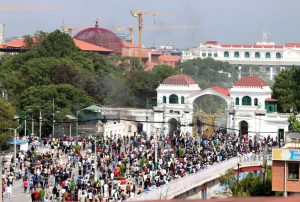
Kathmandu, Sept 10: The Gen Z revolution on Tuesday brought down the KP Sharma Oli government, forcing the nation into another phase of political change and volatility. The key buildings of parliament, government and judiciary were gutted in arson, the horrific events never seen in the modern history of Nepal.
On Monday, the Gen Z launched a protest against the ban on social networking sites and widespread corruption but the peaceful protest turned violent when the police fired on young protesters with bullets, killing more than 20 people and injuring over 400, mostly college-going students.
The next day, the irate protesters defied curfew and rushed to the streets to fight against the government. They set fire to the Singha Durbar, Supreme Court, parliament, special court, official residences of the prime minister and president, houses of different political leaders, schools and business complexes. Thick plumes of smoke rose into the sky of Kathmandu. The autocratic prime minister Oli and powermonger Sher Bahadur Deuba, president of Nepali Congress, have been responsible for the massacre of young people, pushing the nation into another cycle of chaos. Oli fled his official residence in Baluwatar shortly before the agitators barged in and burnt it down.
Protesters beat up Deuba and his spouse, Arzoo Deuba, finance minister Bishnu Paudel and other leaders from the ruling parties. Many of them have hidden in secret places to avoid the wrath of agitators. President Ram Chandra Poudel and Chief of Army Staff Ashok Sigdel have called upon the protesting youths to come to the negotiating table by halting all protest programmes. Army chief said that it was the responsibility of all to protect public and private property and that of diplomatic missions.
On Monday, Zen G demonstrators took to the streets, demanding that the government lift the ban on social networking sites and check corruption. On the second day of movement, the events occurred in quick succession. Before resigning from his post, Oli called for a political solution to the ongoing crisis. Chief of security agencies, including the Nepal Army, in a joint statement, have appealed to citizens to maintain restraint and find a peaceful solution through political dialogue as early as possible.
Generation Z (Gen Z) is one of the most educated generations able to handle the bitter economic and social realities they are facing. They grew up with the internet, smartphones and social media and were exposed to economic and climate crises roiling the society. The term Zen G has become a rallying point to unite the youths disappointed with the regime.
They are capable to utilise diverse digital platforms to build a vibrant public spheres to share ideas and feeling as well as find solution to burning social problems. Chronic corruption, misrule, unemployment, and outmigration caused frustration among the young generation people. The political establishment benefitting from their nexus with power centres has buried their heads in the sand, ignoring the seething troubles. The ban on social sites was the final straw that broke the camel’s back.
The Gen Z revolution that swept the nation in two days was historic. It is entirely different from those engineered by the political parties. It has ended the relevance of Nepali Congress and CPN-UML that boast of leading the nation’s democratic movements in the past. This revolution amply implies that social upheavals occur even when they are not led by the organised forces. It has effectively tamed the corrupt political class and opened the possibility of having a clean government and governance. Nonetheless, it is uncertain how the ongoing movement finds a logical landing. In the absence of credible leader, the movement risks ending in a fiasco. But the protesting forces must utilise this occasion to bring transformative changes to the life of people.