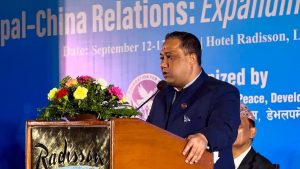
Kathmandu, Sept 12: Minister for Foreign Affairs Shishir Khanal has underscored the importance of advancing Nepal-China relations beyond conventional border management, advocating for a strategic partnership centered on environmental cooperation, climate security, technology, trade, and infrastructure development.
During a programme titled “Nepal-China Relations: Expanding Horizons of Cooperation,” part of the “Kasthamandap Dialogue” Series-3, organized by the Foundation for Peace, Development, and Socialism (FPDS) in the capital today, he noted that the recent floods in Bhotakoshi illustrate that the border between Nepal and China transcends mere political delineation; it signifies a shared ecological destiny.
Describing the Bhotekoshi flood on August 26 as a “Himalayan Tsunami,” the Foreign Minister expressed his appreciation to the Chinese government for its emergency aid, technical assistance, and hydrological coordination during the post-disaster recovery efforts. “Geography not only delineates the political boundary between Nepal and China, but it also intertwines our shared fate,” Minister Khanal remarked.
He emphasized that the Himalayas should no longer be perceived as obstacles or separations, but rather as a collective ecological heritage that necessitates preservation. He contended that environmental resilience and climate security ought to be the cornerstone of Nepal-China collaboration in the context of climate change and escalating environmental challenges.
Minister Khanal suggested initiatives such as real-time satellite data sharing, collaborative weather forecasting, and an early warning system to alleviate cross-border disasters like landslides, erratic weather patterns, and other climate-related occurrences. He concluded, “The Himalayas should be regarded not as a division, but as a shared sanctuary that we must safeguard together.” Foreign Minister Khanal emphasized that the bond between Nepal and China is founded on centuries of civilization.
He reaffirmed Nepal’s strong and clear commitment to the “One China Principle”, ensuring that its territory will not be used for any activities that could harm its neighbors. Minister Khanal also pointed out that the current government, formed after the general election, is prioritizing good governance, addressing systemic issues, promoting social justice, and striving for comprehensive prosperity.
He believes that Nepal’s foreign policy should serve as a foundation for economic growth. Under this vision, the idea of ‘Thick Connectivity and Thin Borders’ has been embraced as part of Nepal’s economic diplomacy.
The foreign minister emphasized the urgent need to modernize customs infrastructure at North border point, develop the high Himalayan border port into a year-round commercial hub, and enhance roads, bridges, and cross-border infrastructure to withstand floods, landslides, and other environmental challenges.
He noted that Nepal can draw valuable lessons from China’s success in poverty alleviation, rural revitalization, and agricultural modernization. Minister Khanal acknowledged China’s rise as a global leader in green technology, robotics, and generative artificial intelligence.
Chinese Ambassador to Nepal, Zhang Maoming, underscored the importance of both nations collaborating to tackle the pressing issue of climate change, given their shared Himalayan ecosystem.
He expressed sorrow over the devastation caused by recent floods and shared details about the assistance China has provided to Nepal.(RSS)
-TRN Online